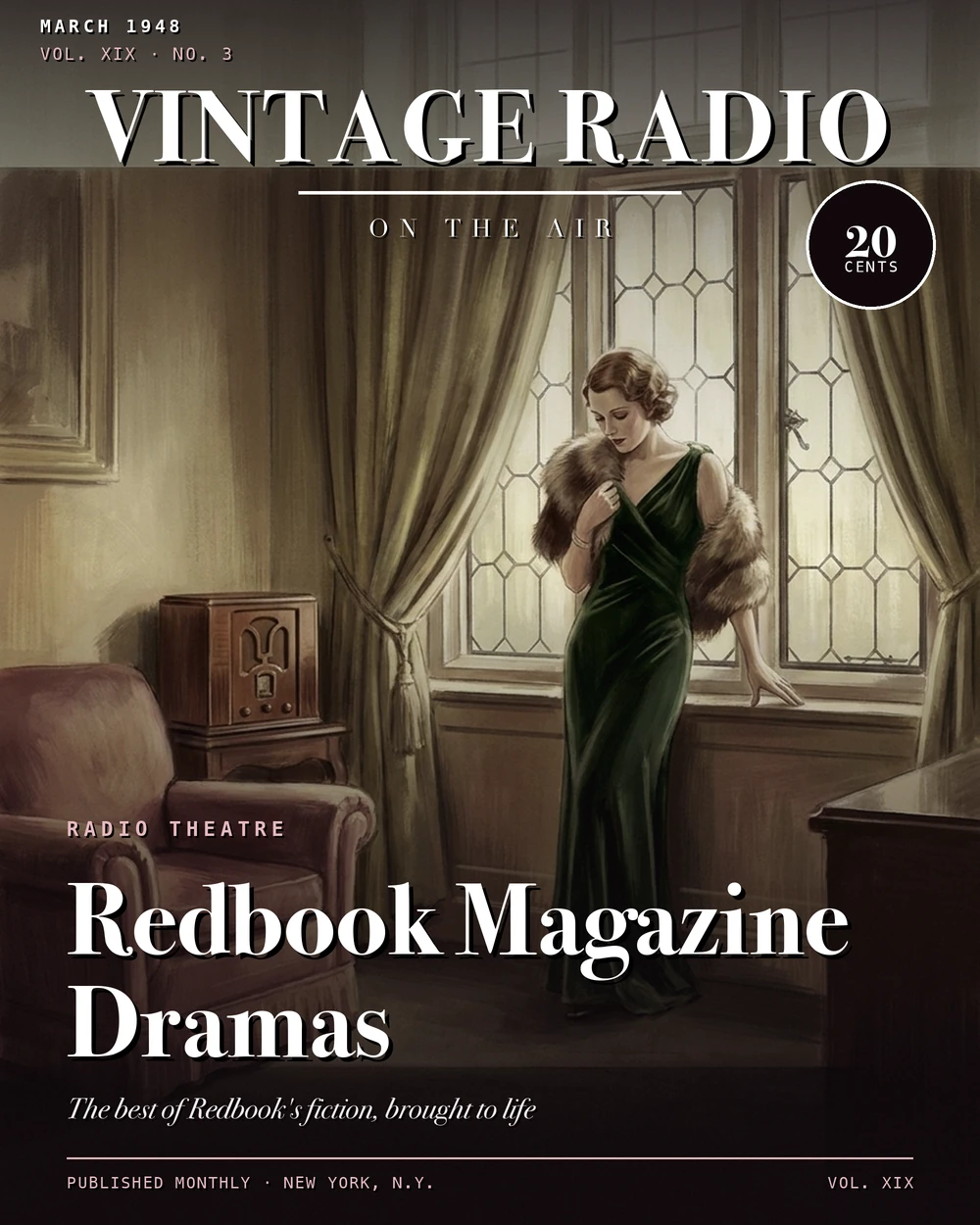
Redbook Magazine Dramas
A Magazine Comes to Life on the Air
In the spring of 1932, Redbook magazine did something relatively unusual for a print publication: it took its fiction catalog directly to radio. Redbook Magazine Dramas premiered on May 26, 1932, as a syndicated anthology drama — not a network broadcast, but a distributed series that stations could pick up independently. Each episode ran fifteen minutes, tight enough to adapt a single short story without padding, and the series ran through November 3, 1932, producing nineteen episodes in total. That format, a magazine brand lending its name and editorial voice to a radio adaptation series, anticipated what larger productions like Campbell Playhouse and Lux Radio Theatre would do later in the decade.
What set this series apart from those later prestige productions was its direct editorial connection. Edwin Balmer, who had served as editor of Redbook since 1927, hosted the program himself and personally selected the stories for adaptation. For the first twelve surviving episodes, Balmer provides a brief spoken introduction to each story and its author — which means the series was, in a real sense, an extension of his editorial vision rather than simply a licensing arrangement. His voice gave the program an unusual degree of coherence for an anthology format.
Edwin Balmer and the Redbook World
Edwin Balmer (July 26, 1883 – March 21, 1959) is probably better remembered today as a novelist and science fiction writer than as a radio host. His co-authorship of When Worlds Collide (1933), written with Philip Wylie, secured his place in the science fiction canon. But through the late 1920s and into the 1940s, his day job was running one of America's popular fiction magazines, and he shaped Redbook's voice considerably during that stretch.
Redbook had been acquired by the McCall Corporation in 1929, which also changed the publication's name from The Red Book Magazine to the cleaner single-word Redbook. Balmer stayed on as editor through the transition and continued in that role until 1949. Under his editorship, the magazine published fiction by Booth Tarkington, F. Scott Fitzgerald, and Dashiell Hammett, and ran nonfiction by Eleanor Roosevelt — a roster that reflects a magazine with genuine literary ambition alongside its popular appeal. The radio series was described by at least one contemporary source as Balmer's "Magazine of the Air," a phrase that captures his thinking about it: radio as another medium for the same stories he was championing in print.
From the thirteenth surviving episode onward, Balmer no longer appears on the program. No explanation survives in the record. The show continued, but without its editorial host, the personal curatorial voice that had defined the earlier episodes quietly dropped away.
What the Stories Were About
The episode titles alone give a sense of the range Balmer was working with: "Under the Midnight Sun," "A Pass to Pekin," "Tribal Law," "Hate and Twenty Cents," "Zhulie." The series moved through emotional domestic dramas, adventure stories set in far-flung locations, and material that engaged directly with contemporary American anxiety. Listeners were carried across a wide geographic spread — Yucatan, France, Dalmatia, Manchuria — while other episodes stayed close to home and hit harder for it.
The Great Depression was a live condition in 1932, and several episodes registered that directly. "He Knew Women" and "Kiss and Jail" both feature families devastated by the stock market crash, the kind of subject matter an audience living through economic collapse would have recognized immediately. The series was noted as a relatively distinctive offering for its attention to women's experiences and themes — relationships, family dynamics, societal expectations — which tracked with Redbook's existing readership, a magazine that had long considered women its primary audience.
The writers behind the adaptations included some recognizable names from the era's fiction world. Frank R. Adams, a prolific contributor to popular magazines including Munsey's and The Smart Set, wrote "A Gent Passes By." Elaine Sterne Carrington (1891–1958) wrote "The Kid" — the episode that also features the series' most identifiable performer. Carrington later became one of radio's most successful drama writers, creating the soap operas Pepper Young's Family and When a Girl Marries, a trajectory that earned her the nickname "Queen of Soapers." Her contribution to Redbook Magazine Dramas came well before that reputation was established.
The Cast and Florence Halop
The casting of Redbook Magazine Dramas is, for the most part, anonymous. Across all surviving episodes, only one performer is identified by name on-air: Florence Halop, who plays the eight-year-old girl in "The Kid." The rest of the cast goes uncredited, and from the audio it appears the core group of performers remained consistent throughout the run, with no guest stars brought in for individual episodes. For a syndicated anthology of the early 1930s, that kind of stable, unnamed ensemble was common — production economics didn't support the star-centered approach that network programs could occasionally afford.
Florence Halop (January 23, 1923 – July 15, 1986) was, at the time of her appearance, approximately nine years old and already a working radio performer. She had been doing radio work from the age of four, which made her one of the more experienced child performers of the era despite her age. Her name appearing in the on-air credits of "The Kid" is a small but notable anomaly in an otherwise anonymous production — a sign that even in a low-budget syndicated series, a genuinely accomplished child performer was worth acknowledging.
What Survives
Nineteen episodes are cataloged from the series' run between May and November 1932. A maintained set of all known surviving episodes has been issued and updated, with the most recent revision in October 2024. That level of documentation is meaningful for a syndicated program from this period — syndicated series of the early 1930s were produced outside the network infrastructure that occasionally preserved recordings, and many survive in fragmentary form at best.
The fifteen-minute episode length, consistent across the extant recordings, made the series practical for syndication: a short, self-contained unit that fit easily into a station's schedule. That format also enforced a kind of discipline on the adaptations — there was no room for leisurely storytelling, and the stories that worked best in the format were probably those that already had the tight construction of good short fiction. Redbook's editorial standards under Balmer, whatever their limitations, at least pointed toward that kind of material.
As a syndicated anthology drama from 1932, Redbook Magazine Dramas doesn't occupy the same place in the old-time radio record as the network prestige programs that came later. But it represents something real: a print publication with a distinct editorial identity trying to carry that identity into a new medium, with its own editor as host, in the middle of the Depression, working in a format that demanded efficiency and delivered variety. The nineteen episodes that survive are a reasonably complete picture of what that experiment looked like.